First example of event diary share
The site said one login and had nowhere to perform one. Now there is a sign-in, and an account page you can actually act on.
 Michael StatonMusic Editoraugmented with Claude Code on Claude Opus 5 (1M context)
First example of event diary share
Why Care?
didi.sh said one login across every service in its hero, and there was nowhere to perform one.
The primary call-to-action pointed at https://id.didi.sh/, which was a spec
page with three theme toggles on it. Neither the site nor the splash had a
sign-in control anywhere. And / on the identity service itself was still
serving Phoenix's generated scaffold — "Peace of mind from prototype to
production" — because the real home page had been written, committed and
pushed weeks ago, and simply never deployed.
None of that was broken code. All three were capability without a surface.
What's New?
GET /auth— a hosted sign-in. Email in, single-use link out.GET /account— what your credential resolves to, and the controls to change it.A
Sign incontrol on both didi.sh and the splash.The service's own front page, which had been sitting in
mainundeployed.
The account page
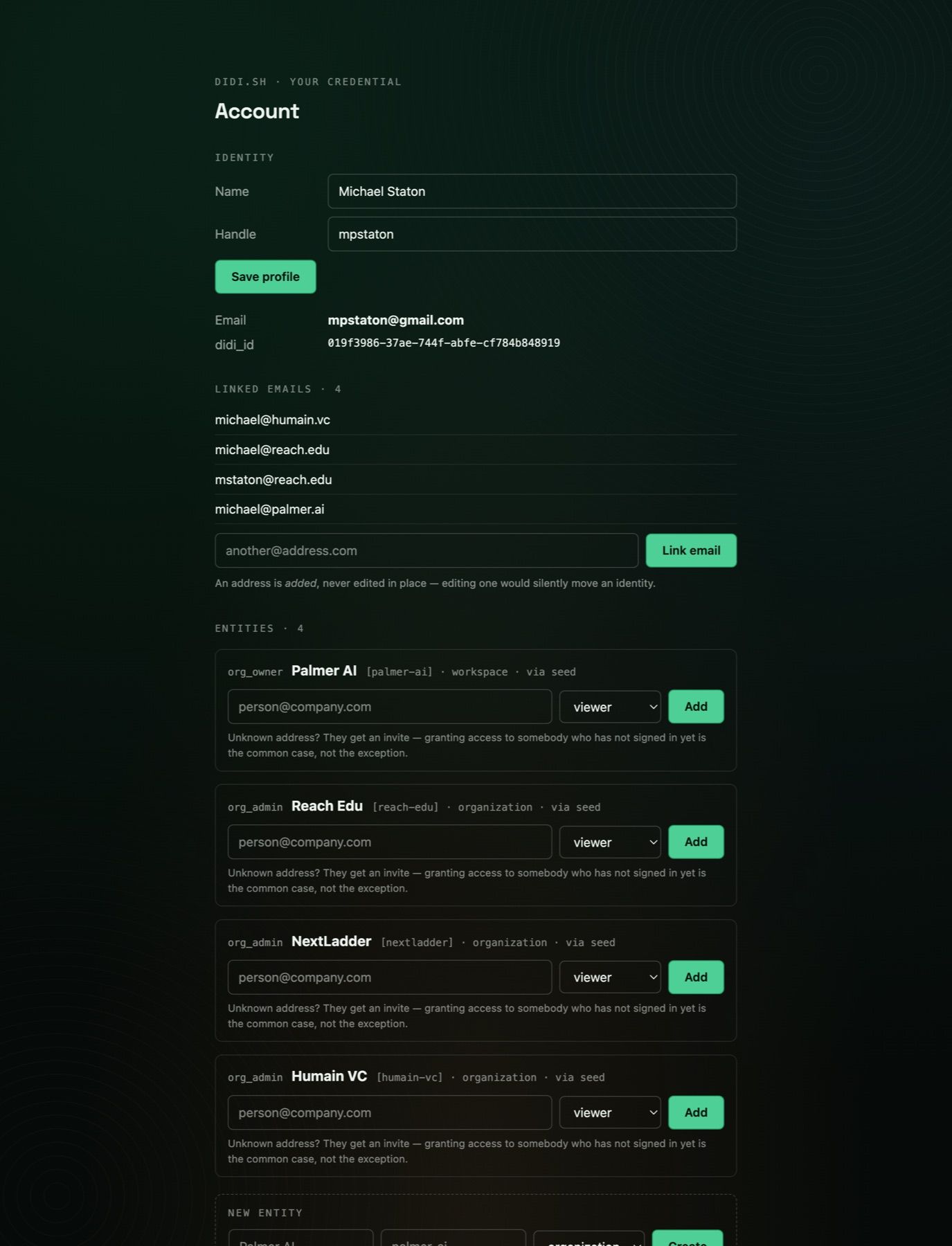
Signing in used to end at "your session is live across every didi.sh service, you can close this page" — true, and unverifiable, with no link anywhere. The first question anyone has after signing in is whether it worked: which identity am I, which entities do I belong to, is the key resolving.
So the page answers those, and then lets you act on them: edit your name and handle, link another address, create an entity, and add someone to any entity you administer.
It is the browser view of GET /api/me — same data, same source, no second
notion of identity. Every write calls the same context function the JSON API
calls. One rule, two surfaces; they cannot drift because there is only one place
the rule lives.
The keys section deliberately stops at a link. /keys is the lender's screen and
rebuilding paste-lend-meter-revoke here would be a second implementation of the
one thing that must never have two.
Three decisions worth the words
A member is added by email, not by didi_id. Nobody knows their own UUID and
nobody should have to. An unknown address gets an invite rather than a
refusal — granting access to somebody who has not signed in yet is the common
case, not the exception, and a form that refused it would fail at exactly the
moment it matters.
Creating an entity makes you its admin, in the same action. Without that the entity exists and nobody, including its author, can administer it.
An email is added, never edited. update_profile/2 covers name and handle
only. Editing an address in place would silently move an identity; adding one as
an alias is a different, reversible thing.
The bug the page had on day one
It shipped read-only, and it read the wrong table.
organizations (org-wide memberships) and entities (entity_memberships)
both exist — a live decision, recorded in
context-v/issues/Entities-and-Organizations-Both-Exist.md. The page listed the
first while the tenancy primitive, and everything the API manages, is the second.
So it reported one membership and showed a legacy org, while the entities were
invisible.
The fix is not to pick the newer one and move on. Both are shown, and the legacy block is labelled as legacy — because picking one silently is precisely how a reader concludes the other is empty, which is the failure that produced this bug in the first place.
Under the hood
The sign-in is a softening, stated
AccessController says real sign-in UIs live in the apps, which call
POST /api/magic-links from their own screens. That stays true and /auth does
not change it. What the headless posture never covered was somebody arriving from
the marketing site with no app context — and a call-to-action with no
destination is worse than one that does not exist.
So /auth issues the same magic link the API issues and hands off to /access,
which already does redemption. No second code path, nothing new minted.
It never reveals whether an account exists. Every submission renders the same "check your email" page whether or not the address is known, because a different answer for a known address is an enumeration oracle. Verified on all three paths before shipping: the form renders, an unknown address gets the identical page, a malformed one is refused before anything is issued.
Auth is checked in the controller, not by the plug
Plugs.RequireUser halts with a JSON 401. That is right for the API scope it was
written for and wrong for a browser page, where the answer to "not signed in"
is the sign-in page. /account redirects to /auth instead.
And it was a deploy, not a push
Worth recording because the diagnosis was three wrong guesses deep before anyone
checked. The home page was not missing and not unpushed: local was 0 ahead, 0
behind origin/main, and the page had landed in 07ade98. Fly was serving a
build from before it. The "Phoenix error page" was the generated scaffold plus
LiveView's reconnect banner, which reads like an error and is not one.
What's Next
The schema call. Creating those four made
entitiesrows. Whetherorganizationscollapses intoentitiesis still open, and this page now makes the split visible rather than hiding it — which is the honest state until it is decided.Handles on entities are the identity now.
[reach-edu],[humain-vc],[palmer-ai],[nextladder]— not the email domain, which cannot work for an org whose people hold addresses somewhere else.Removing a member, and leaving an entity, are API-only.
Related
context-v/issues/Entities-and-Organizations-Both-Exist.md— the two-table decision this page stopped hidingcontext-v/issues/Splash-And-Site-Have-No-Agreed-Division-Of-Labor.md— why the button went on both surfaceschangelog/2026-08-20_01_Entities-Land-Flat-And-Invites-Reach-Strangers.md— the primitive this surfaceschangelog/2026-08-21_01_Lend-A-Key-Keep-The-Receipts.md— the/keysscreen this links to