The desktop app catches up with the corpus
Wired the new store into the app, opened it, and got a blank window. Drawing a header was reading 845 files.
 Michael StatonMusic Editoraugmented with Claude Code on Claude Opus 5 (1M context)
The desktop app catches up with the corpus
Why Care?
Earlier today the corpus learned two new tricks: every PDF moved into a content-addressed store — one copy, compressed, fetched on demand — and a change feed started rendering what we did and why in language a client could read.
Both were true only in the terminal. The desktop app knew nothing about either.
A source whose PDF now lived in bin/ looked, on screen, exactly like a source
with no PDF at all.
This is the entry where the screen catches up. It is also the entry where opening the app turned out to be reading the entire corpus to draw a header, and we can say exactly how much that cost.
What's New?
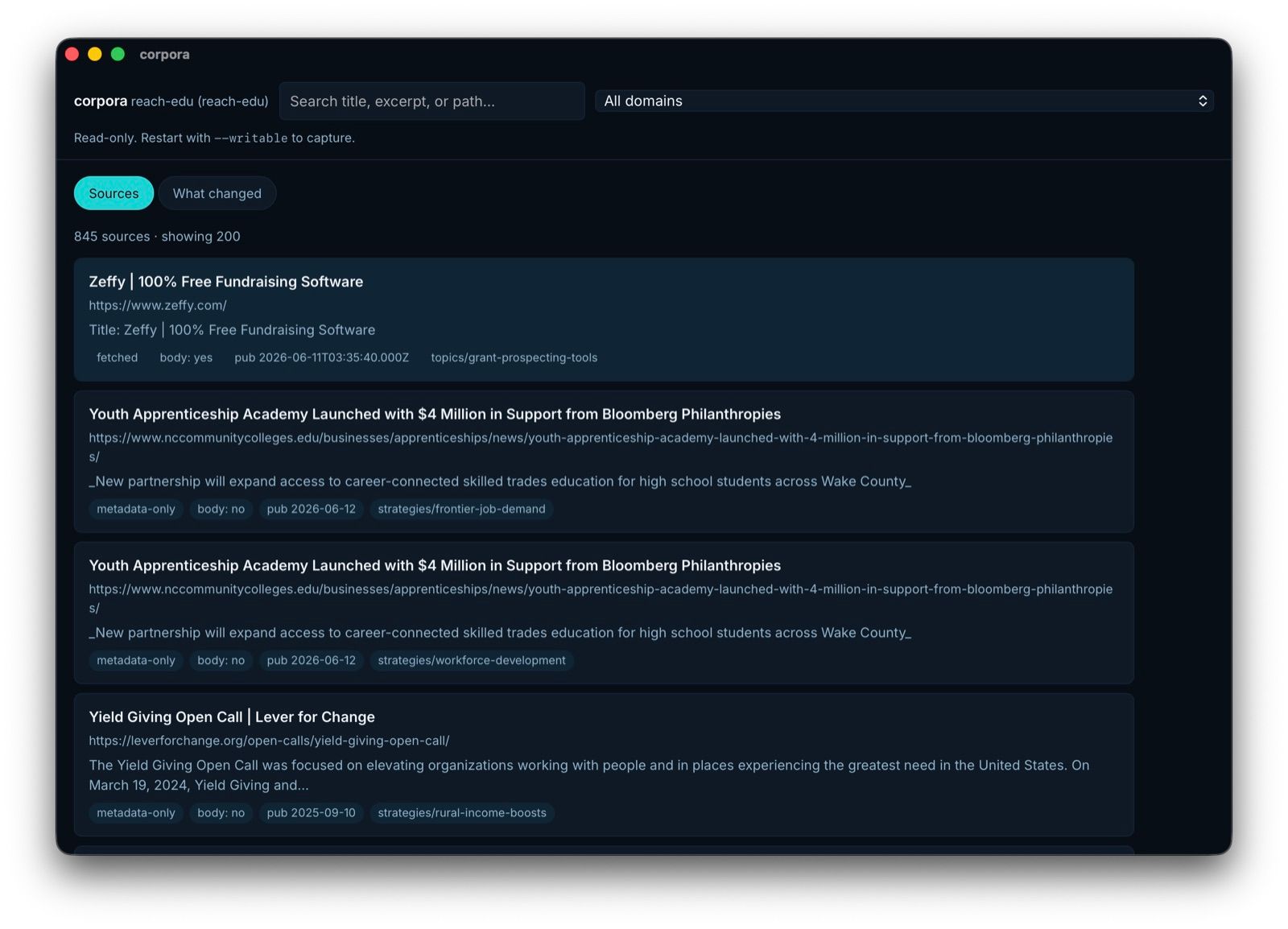
Sources carry their binary. Each row says whether its PDF is on this machine, how big the working copy is, and whether it was optimized — with an Open or Download link accordingly.
A "What changed" tab. The change feed, rendered from the same records
corpora changesprints, so the screen and the CLI can't drift into two notions of what happened.corpora fetch— get any binary back by key, or by handing it the wrapper that names one.Opening the app got ~25× faster.
/api/metawent from 20.6 seconds to 0.8; a fifty-row page from about 20 seconds to 2.8.
The blank window
The wiring went in, the app launched, and this happened:
Starting the backend…
Nothing else. Forever, as far as anyone watching was concerned.
The sidecar was fine — /healthz answered instantly. The Rust shell had spawned
Python exactly as designed. What we had was a healthy backend and a window that
would not paint.
/api/meta was taking 20.6 seconds.
It returns four things: a label, a count, a domain list, and a writable flag. To
get the count and the domains it called list_sources, which read all 845
markdown files out of Cloudflare R2, parsed each one, and threw away everything
except two numbers.
Both facts live in the key.
def list_domains(store, prefix=""):
    keys = [k for k in store.list(prefix) if k.endswith(".md")]
    return len(keys), sorted({_domain_of(k) for k in keys})
One list() call. No file body opened. 20.6s → 0.8s.
Which only moved the problem
With meta fast, the first /api/sources call inherited the cost — because it
too read every file, then sliced the result down to a page.
So an unsearched listing now pages over keys before reading anything. Fifty rows costs fifty reads instead of 845.
That trade has a real edge worth naming: ordering switches from fetched_at
(inside the file) to the filename's date prefix. The naming convention writes
that prefix from fetched_at, so the two agree — and a file predating the
convention sorts by name, which is an honest fallback rather than a confidently
wrong date. A search still reads everything, because it has to, and a search
is a deliberate act rather than a page load.
And that left the latency
Fifty sequential GETs against R2 at roughly 140ms each is seven seconds of waiting rather than working. The page now reads through a thread pool, with order restored afterward.
| before | after | |
/api/meta | 20.6s | 0.8s |
/api/sources?limit=50 | ~20s | 2.8s |
Under the hood
The tests assert reads, not seconds
listing = list_sources(store, limit=10)
assert listing.total == 40   # the count is still honest
assert store.reads == 10     # ...but only ten files were opened
A performance promise measured in wall clock is a promise that passes on a fast laptop and rots quietly. Counting reads is the thing we actually mean.
Three schemas, met where they are
Two rows rendered 0 B. It turns out reach-edu carries three shapes of
binary_asset: fetched PDFs use size_bytes and content_type; uploaded ones
were recorded with bytes / original_bytes / compressed by an earlier
pipeline that did its own compression; and today's migration added
binary_key / optimized.
We modelled all three rather than migrating them. Rewriting a client's frontmatter to tidy a synonym is exactly what the pointer module was built to refuse.
One read that writes
/api/binary is allowed on a read-only server. Populating a local cache from
an immutable, content-addressed object cannot alter the corpus — so this is
stated in the spec rather than left to be rediscovered and "fixed" by gating it
behind --writable later.
The bug that was almost invisible
create_app hardcoded the machine-level cache. A test evicted a binary, asked
the app about it, and was told present — because the app was reading whatever
this laptop happened to have downloaded. The cache is now injectable.
That is the third false-green of the same shape in one day, and the pattern is worth stating plainly: a test that does not control its environment is testing the environment.
What's Next
Wire capture's binary path into the screen — new captures already file into
bin/correctly, but the capture form doesn't say so.Kill the last cold cost. 2.8s to first paint is livable, not good.
The
not_downloadedaffordance is untested by a human. Every binary in reach-edu is currently cached locally, so nobody has yet clicked Download PDF on a cold machine.
Related
changelog/2026-08-22_02.md— the change feed this surfaceschangelog/2026-08-22_03.md— thebin/store this makes visiblecontext-v/specs/Browse-Corpus.md— behaviours 10–13, and the read-count promisescontext-v/specs/Binary-Ingest-And-Bin-Store.md— wherenot_downloadedis defined as a state rather than an error