Integration with Claude Design to Refactor Frontend and Converge on a True Component Library
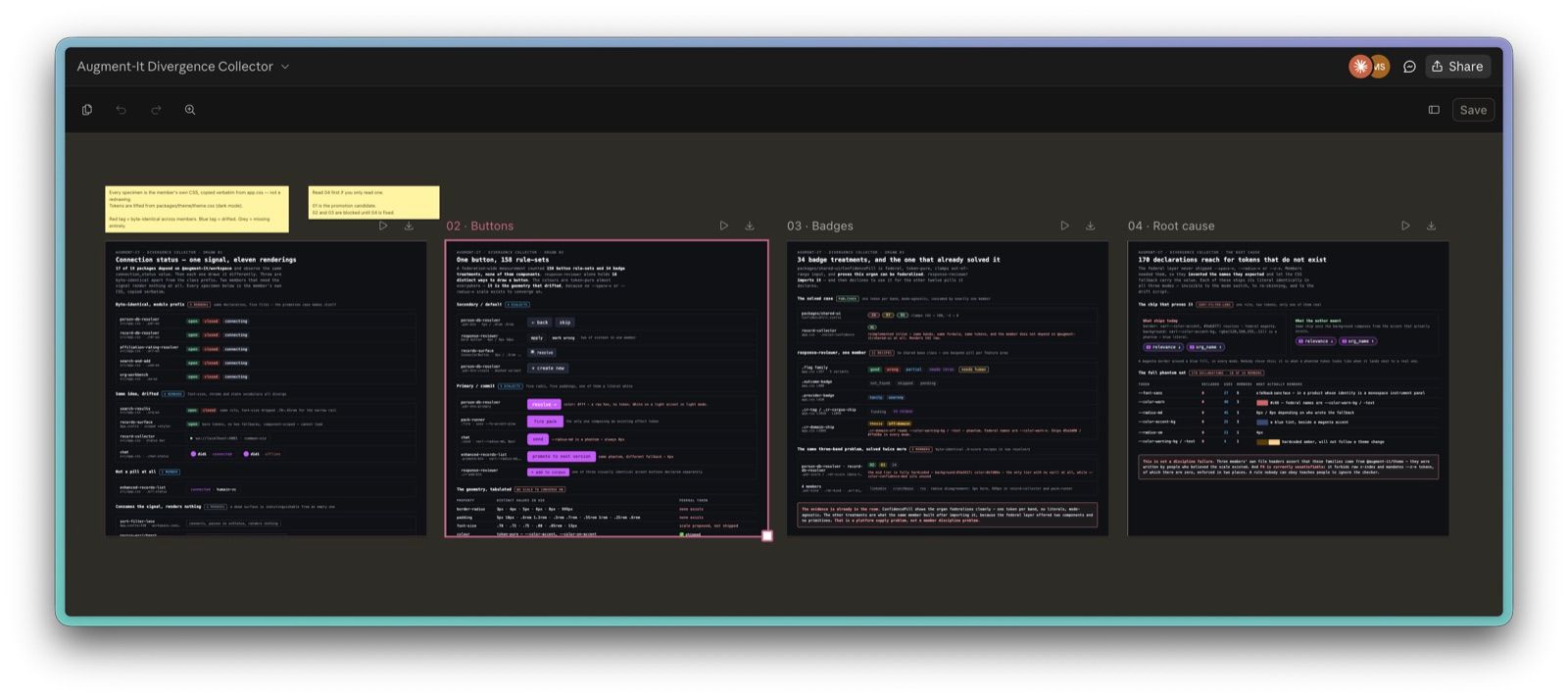
Nobody had ever seen the eleven status pills next to each other. Put on one canvas, the promotion argument makes itself in about four seconds.
 Michael StatonMusic Editoraugmented with Claude Code on Claude Opus 5 (1M context)
Integration with Claude Design to Converge on a True Component Library
Why Care?
We used to run design through Figma. Agentic engineering ended that — everyone goes straight to code now, and the tool went with it. What we lost was not the drawing. It was the shared visual reference that made disagreement visible before it was committed.
Going straight to code did not remove the disagreement. It moved it downstream, where it shows up as sixteen ways to draw a button.
augment-it is heading toward one repo per app, owned by teams of one to three.
The architecture is already shaped for it. The moment a member leaves the
monorepo, cross-member duplication stops being greppable — everything not
converged before the split is converged never.
So the question was never "can we enforce conformance." It was: can a platform team see divergence early enough to have an opinion about it, without becoming a gate that kills the speed small teams are for?
A canvas turns out to be the answer, and for a duller reason than expected. Drift is a visual phenomenon. The registry we built is a table of file paths, and a table has never once made anyone say "wait, those are the same thing."
What's New?
The convergence loop — two channels, five verdicts, and a fingerprint ledger
The organ registry — 24 organs, 17 with cross-member evidence, each with a verdict
pnpm organ:drift— generates the duplication table instead of asserting itThe Divergence Collector — four artboards rendering the actual product CSS
Two refactor docs for the federal defects the sweep surfaced
The governance model, in one rule
Creativity stays the default. The federation contract already says so in as many words — "What a local system may do without asking: Everything else." A platform team that reviews every component kills the thing that makes small teams fast.
So the loop is not an approval gate. It is an instrument, plus a vocabulary for deciding, that includes "nothing, this is fine, write down why."
The difference between purposeful variation and drift is not a property of the code. It is whether a human wrote it down. Two members deliberately diverging is healthy and gets recorded as
sanctioned. The same two diverging by accident is drift. The code is identical in both cases. Only the registry distinguishes them.
That makes the registry the governance mechanism rather than a report. Five
verdicts give every finding somewhere to land — PROMOTE · CONVERGE · SANCTION ·
DEMOTE · WATCH — and SANCTION matters most, because it is how the instrument
says "these differ on purpose" without pretending the difference is a defect.
What four scanners found
Four read-only agents swept 19 members and the platform layer. The unit of analysis is the organ — a recurring UI concept, not a file. One organ may be a component in one member, inline markup in a second, and a CSS class recipe in a third; a sweep that compares filenames finds the easy half and reports clean.
The strongest promotion candidate is one nobody nominated. 17 of 19 packages
depend on @augment-it/workspace and observe the same connection_status
value — then render it eleven different ways. Five are byte-identical apart
from the class prefix. Two members that need the signal render nothing at all, so
a dead surface is indistinguishable from an empty one. And zero of the eleven
are accessible: no role="status", no aria-live, no accessible name anywhere
in the set.
That is the whole promotion argument, and on the canvas it takes about four seconds instead of a meeting.
The finding that changed the plan
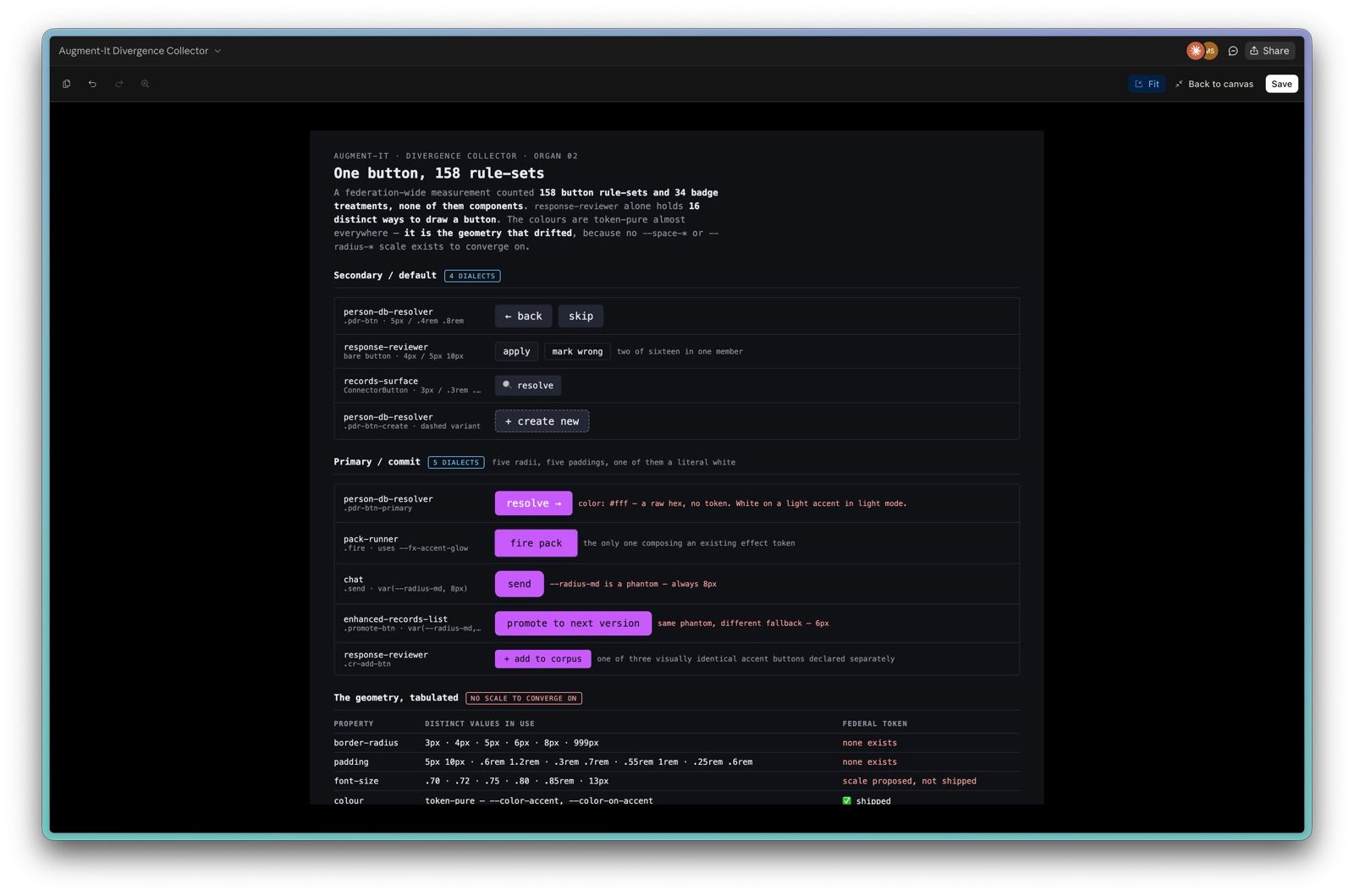
A federation-wide measurement counted 158 button rule-sets and 34 badge
treatments, none of them components. response-reviewer alone holds sixteen
distinct ways to draw a button.
The obvious move is to promote a Button. We deliberately did not, and the
Buttons artboard is why. Look at the bottom table: the colours are token-pure
almost everywhere — it is the geometry that drifted. Six border-radius values
and five paddings in active use, against a federal token count of zero for both.
All four scanners then reached the same root cause independently, without being asked about tokens:
--space-*    0 declarations in packages/theme/theme.css
--radius-*   0 declarations
--z-*        0 declarations
Members needed them. The vocabulary did not have them. So they invented the names they expected to exist and let the CSS fallback carry the value — 170 declarations across 10 of 19 members now reference tokens that do not exist, each shipping its literal identically in all three modes.
This is not a discipline failure. Three members' own file headers assert that
these families come from @augment-it/theme; they were written by people who
believed the scale existed. A related consequence: F4 is currently
unsatisfiable — it forbids raw z-index and mandates --z-* tokens, of which
there are zero, enforced in two separate places. A rule nobody can obey teaches
people to ignore the checker.
Promoting a Button today would bake the drift in. A promoted component must pick one radius and one padding. Picking them from that table — rather than from a named scale — makes one member's accident into federal law. The token families come first.
When Claude Design earns its place
Worth stating, because the timing is the whole recommendation:
Diagnostic use is ready now. The variant wall depicts reality, broken parts included. It needs no decisions and no fixed token layer.
Generative use is blocked until the scales ship. Designing against a vocabulary with holes expresses every decision as a number, because there is no name to reach for — manufacturing the exact drift we just measured, with visual authority behind it.
Claude Design's value is proportional to the completeness of the token layer. A design tool without a design system produces pictures, and pictures do not converge anything.
The mechanic matters too: the artboards are HTML and CSS, so they are drawn with
the product's actual theme.css and the actual component markup. It is not a
redrawing of the component — it can be the component. That is the property Figma
never had, and it is what makes a decision made on the canvas mean something in
code. The round trip is still manual: Claude Code drafts, a human refines
visually, Claude Code transcribes back into Svelte. There is no automatic sync.
The push channel already existed
The strongest evidence for the governance model was not in the CSS. It was in the comments. Teams were already flagging their own duplication, in the commit, at the time — one cites the tracking issue by number:
"ResultRow/ResultsList copy-adapted from search-and-add (spec D7: per-remote copies, no shared runtime; knowingly more fuel for the component library, gh #22)."
Three separate members name the file they copied and the debt they took on. Nobody was careless. There was simply no registry for that declaration to land in, so it stayed in a comment nobody aggregates.
The push channel does not need building. It needs somewhere to write to.
One thing measured that we had backwards
DESIGN.md recorded four "byte-identical" promotion candidates on 2026-07-30. The
first read of the re-measurement was "two of them drifted while sitting in a
queue meant to catch drift."
That was wrong, and the truth is worse. git show at birth, at 2026-07-30 and
at HEAD says ColumnMapper and RecordCard were never byte-identical at any
commit in the repository's history, and neither has changed since. Both were
copy-pasted at birth — the copy happened in a clipboard, not in version control.
Nothing drifted. The list was wrong the day it was written, because
byte-identity was asserted rather than measured, and every reader inherited the
error for six weeks. That is a better argument for the tooling than the original
one: the fix is not re-measure more often, it is never hand-write the
measurement. pnpm organ:drift generates that table, which is why it can be
trusted and the prose above it cannot.
What is not done
Being clear-eyed: nothing in the design system was fixed. The 170 phantom
declarations are still there. sort-filter-lens still leaks 61 unnamespaced
classes that collide with .error, .row and .muted across 16, 19 and 14 other
surfaces. No component was promoted. No organ converged.
This shipped a plan and an instrument, not a fix. The queue:
Ship the missing token families — unblocks Button and Badge promotion
Add the global
:focus-visible— one declaration, whole-federation effectPromote the connection-status pill — the evidence is already overwhelming
Contain
sort-filter-lens— mechanical, verifiable, one afternoon
Where the canvas lives. The artboard sources are working files under
design-canvas/and are gitignored — the published Artifact is the deliverable, and re-seeding regenerates the page from those sources. They are build inputs, not repo content, on the same reasoning that keeps.image-staging/out of git.
Related
Converge-The-Federated-Design-System.md — the loop
Design-System-Convergence.md — the organ registry
The-Federal-Layer-Never-Shipped-Space-Radius-Or-Z.md — the root cause
The-Sort-Filter-Lens-Containment-Breach.md — the live F3 breach
No-Component-Library-UI-Improvised-Not-Component-Based.md — the 2026-07-24 admission that seeded this