Setting Up to Retrofit Lossless Disciplines & Vigilance
Forty deployable units, fourteen READMEs, zero component design systems. We audited our own flagship against the advice we give clients.
 Michael StatonMusic Editoraugmented with Claude Code on Claude Opus 5 (1M context)
Setting Up to Retrofit Lossless Disciplines & Vigilance
Why Care?
We tell clients three things about building software in the agentic era. Code is regenerable given proper context, so context is the durable asset. Decompose harder than feels justified — microservices and microfrontends, each in its own repo — because agents are fast enough that quality control, not authorship, becomes the bottleneck. And apply API-first, documentation-first, design-system-first, changelog-first to every unit, not just the system.
Augment-it is the project we point at when we say that. So before recommending it again, we counted how well our own flagship actually complies.
It doesn't, in a specific and instructive way: we were rigorous at the system level and absent at the component level. That isn't a random lapse. It's the exact failure mode the recommendations exist to prevent, experienced from the inside rather than asserted from a slide — and it turns out to be the most credible thing we could put in front of a client.
What's New?
A counted self-audit — [[The-Gap-Between-What-We-Preach-And-What-We-Practiced]], the numbers below and what each gap costs
The doctrine, finally written — a blueprint stub dormant since 2026-06-01, whose body literally read "to develop with the user," developed into the three-part argument including why adopting decomposition alone is the anti-pattern
Two remediation plans — per-component contracts, and visual engineering as a standing practice rather than a one-time event
Two loops — one to endow a single component with its contracts, one (a stub) for creating and updating Archify diagrams
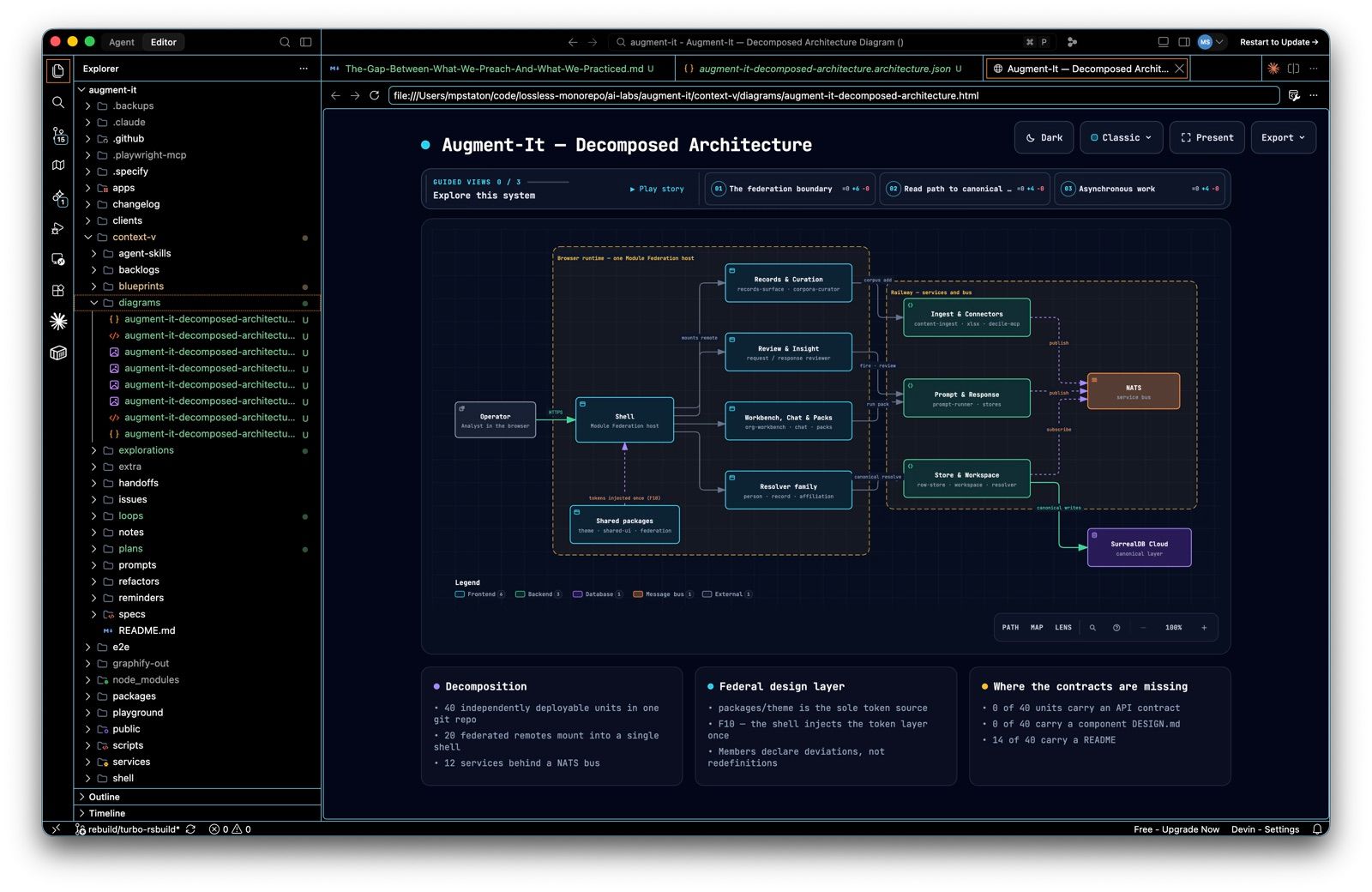
Archify installed into the tree as a nested submodule, and the first architecture diagram augment-it has ever generated of itself
The audit, counted
Augment-it is 40 independently deployable or publishable units: 1 shell, 20 federated microfrontends, 12 microservices, 7 shared packages.
| Artifact | System level | Component level |
README.md | ✅ | 14 / 40 |
DESIGN.md | ✅ + design-manifest.json | 0 / 40 |
changelog/ | ✅ 101 entries | 0 / 40 |
context-v/ | ✅ 196 docs, 14 folders | 0 / 40 |
| API contract | — | 0 / 40 |
The README distribution is the diagnostic part. Six of twenty microfrontends have
one — largely the early, hand-built ones. Two of twelve services. Six of seven
packages, the exception being packages/federation, which is the single most
load-bearing contract in the system and explains itself nowhere. The shell, which
hosts all twenty remotes, has none.
Documentation happened where a human sat and thought, and did not happen where an agent generated a working unit and moved on. Velocity outran the contracts.
And the repo shape made it worse. All 40 units share one git repo — one branch, one
PR queue, one CI surface. That was a deliberate deferral at v4.0.0.1, not an
oversight, and the bill arrived on schedule: a
[[2026-08-15_01_Every-Frontend-Deploy-Had-Been-Failing-For-Twelve-Days-On-One-Missing-COPY|twelve-day
silent outage]] from one missing COPY line in a Dockerfile. Every frontend broken,
invisible, because no individual frontend owned a build surface that could go red on
its own. That is a single-repo failure mode in its purest form.
We are not splitting the repo this week — a forty-unit relocation inside this tree trips the anchor monorepo's three-precondition hard stop. The lesson gets named and costed instead.
This is a continuation, not a standing start
The retrofit is only affordable because the expensive half already exists, here and across the tree.
Context vigilance is the part we actually did. 196 documents across fourteen
folders — 35 specs, 37 plans, 31 explorations, 50 issues, 10 blueprints, 5 loops —
plus 101 changelog entries and Spec Kit coexisting with context-v/ rather than
competing with it. The shortfall was never rigor. It was scope: all 196 describe
the system, and not one describes a single component from that component's own point
of view.
Chroma is live as agent-memory and agent-context-search. Four collections in
ai-labs/context-vigilance-kit aggregate the whole tree — section-chunked
context-v/ files, every repo's changelog, every prior Claude Code message turn,
and every prior tool invocation with its success flag — wired into sessions over
MCP. "What did we decide about X" stopped being a question you answer from memory.
Graphify already ran here, and that's the interesting correction. The premise
going in was that we'd never implemented it. Wrong: on 2026-08-06 it extracted
4,330 nodes and 6,011 directed edges across 490 source files for zero tokens —
AST parsing needs no LLM — and produced a real shipped artifact that found ~500
cleanly deletable lines, 11 near-identical mount.ts files, and disproved our
assumption that the frontend was full of copy-pasted CSS.
Then it never ran again. The proof is exact: the graph's community list still reads
"Strategy Curator App." We renamed that app to corpora-curator on 2026-08-08 —
two days later. The instrument is describing a system that no longer exists.
So the 1b gap was never "we don't do visual engineering." We did it once, well, and let it rot. A graph nobody re-runs is a document, not an instrument.
The federated design system is the most complete thing here. packages/theme as
sole token source, an F1–F11 contract, and design-drift.mjs turning those rules
from prose into executed checks — all 108 text-on-surface pairs passing 4.5:1. That
is the shape every other component contract should aim at.
Archify, installed properly
The obvious move was npx skills add tt-a1i/archify -g. We did that first and it
was wrong — the skills manager copies into ~/.claude/skills/ and six other agent
directories, none of them in our tree, none version-controlled.
Removed all six and did it the way Chroma is done: a nested git submodule in the
agent-skills repo, tracked as a gitlink so none of its ~8MB enters our history, and
hand-symlinked because the skill sits one level inside a wrapper repo — the same
nesting that forces chroma-local to be hand-linked. Updates come from git pull,
not from an installer.
context-v/agent-skills/.gitmodules
  [submodule "chroma-agent-skills"]  → chroma-core/agent-skills.git
  [submodule "archify"]              → tt-a1i/archify.git     ← new
The authoring loop is adversarial, and that's the point
The objection to natural-language diagram tools is that an LLM drawing a plausible picture is a hand-drawn diagram with extra steps — it inherits the same silent-rot problem. Archify answers that, and not gently.
Our first candidate returned eleven errors. Not style notes — coordinate-level geometry proofs:
"prompt-bus" shares a 133px corridor with "store-canonical"
  at [1085, 300] -> [1085, 433] (minimum 8px)

Label "row + workspace reads" overlaps component "fe-resolvers"
  label rect: [720, 173, 111, 14]
  component rect: [510, 180, 220, 66]
  Suggested fix: labelAt [775, 260] or labelDy +77 (below)
Restructuring the layout so each microfrontend cluster sat horizontally adjacent to the service group it calls took it to two. Then one of our fixes was wrong — shifting a label 44px left pushed it into another component, and the validator caught that too. A 16px nudge on the other axis cleared it. Final: 9/9 artifact checks, 0 errors, 0 warnings, delivered with SHA-256 receipts for both spec and artifact, then browser-verified at 1440×900 and 2048×1320 in both themes.
You cannot ship a sloppy diagram through this thing. Two details matter more than the
picture: --repo-root makes the architecture type inspect repository evidence
rather than accept a description, and compare --receipt diffs two specs — so a
diagram can announce its own staleness instead of rotting quietly, which is precisely
what the August graph failed to do.
The diagram found something we weren't looking for
Building it forced a reconciliation between DESIGN.md and the disk, and DESIGN.md
is materially stale:
| On disk | In DESIGN.md | |
| Microfrontends | 20 | 16 |
| Shared packages | 7 | 2 |
| Services | 12 | 0 |
Unregistered remotes: docs-portal, org-workbench, search-and-add,
search-results. The document's own description still says "sixteen sovereign
micro-frontends."
This is worse than bookkeeping. design-drift.mjs reads its member registry from
DESIGN.md's frontmatter — so those four remotes are outside F1–F11 enforcement
entirely, silently. It's the same pattern as another finding from the audit: the
[[Sweep-Local-Federated-Design-System-for-Fidelity]] loop instructs agents to read
"the member's DESIGN.md, including Deviations" — a file that exists for zero
members. Tooling pointed at contracts that don't exist yet.
DESIGN.md also can't describe a system on its own: services/ appears zero times
in it. It's a design-system document, and the entire backend half of the diagram had
to come from the directory tree.
What's Next
Re-run Graphify and diff against August. Cheapest high-value move available — zero tokens, the AST cache makes it near-free, and a month of structural change including which
Partially-Shippedrefactors actually landedReconcile
DESIGN.mdso the four unregistered remotes re-enter drift enforcementpackages/federationandshell/first in the contract sweep — everything else binds to one or bothDecide the forcing function. Writing 40 files once doesn't close a structural gap. The strongest option without new repos is making per-unit docs render in the running app, so a service with a blank docs panel is visibly wrong to anyone using it — discipline as part of the demo rather than a tax on it
References
The counts in this entry come from the repository as of 2026-09-13; the audit document carries the full derivation.
[[The-Gap-Between-What-We-Preach-And-What-We-Practiced]] — the audit
[[Augment-It-as-Working-App-and-Architecture-Demo]] — the doctrine
[[Component-Level-Documentation-Contracts]] — remediation for the four "firsts"
[[Graphify-As-Standing-Practice-And-Per-Component-Diagrams]] — remediation for visual engineering
[[Endow-A-Component-With-Its-Own-Contracts]] — the per-unit loop
[[Create-or-Update-Archify-Diagrams]] — the diagram loop (stub)
[[Structural-Refactors-Surfaced-by-the-Codebase-Graph]] — what the August graph produced